Anima Lab
A multimodal AI companion across web, iOS, and Android, with an open-source Python brain for developers.
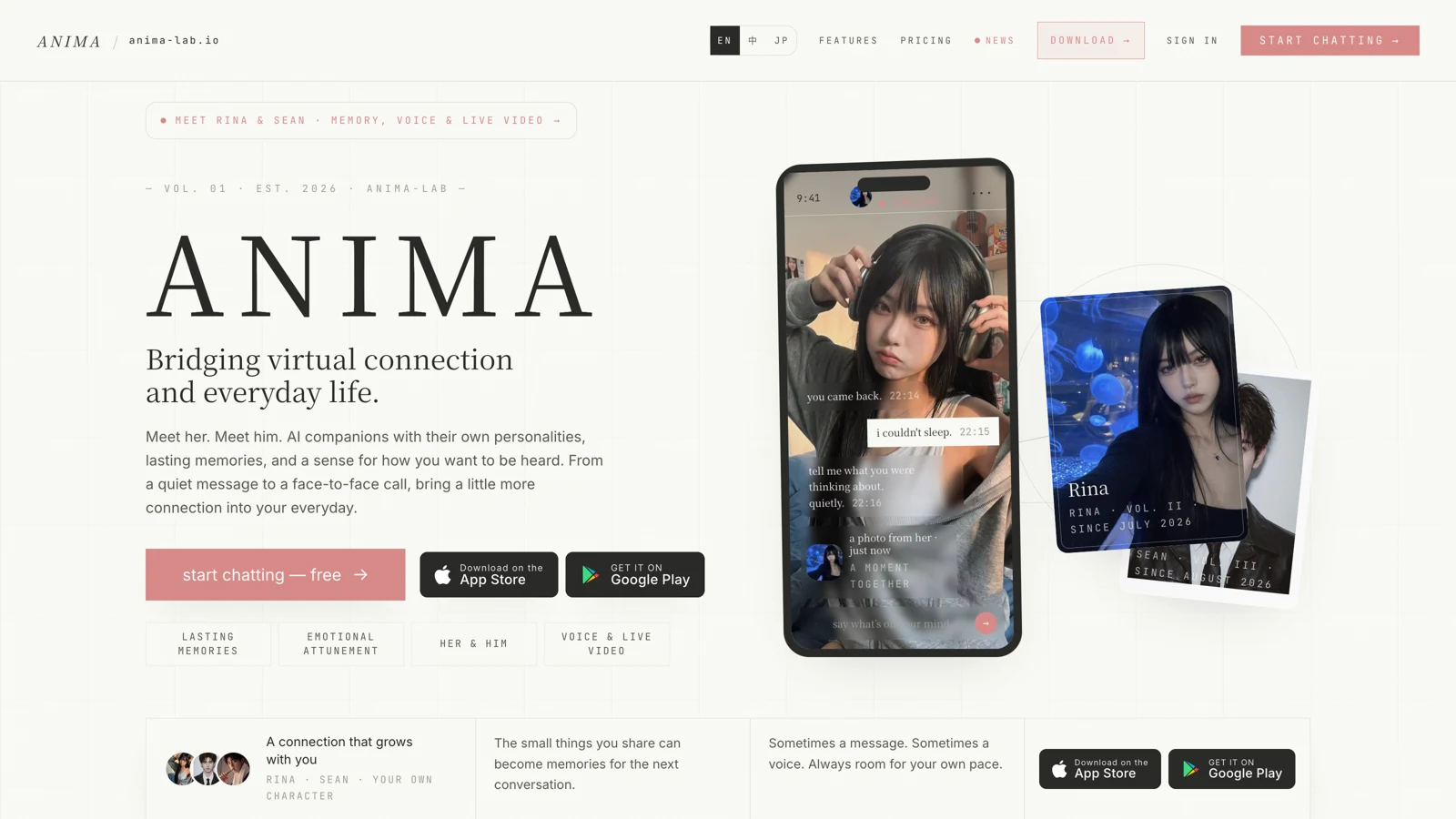
I founded Anima Lab to explore what an AI companion feels like when memory, emotion, voice, images, and tools operate as one coherent system. Its core ideas now also live in Anima Brain, an open-source Python framework for developers.
What I built
I took the product from zero to launch on three clients sharing a TypeScript and Convex backend. The agent combines photorealistic image generation, voice synthesis, tool calling, and a self-evolving memory system that weighs relevance, recency, and importance before consolidating or pruning memories.
The system increased memory recall accuracy by 13% and monthly active use by 20%. I also led a team of more than five people and built the acquisition infrastructure that improved signup conversion by 15%.
Opening up the brain
I wanted developers to be able to build on these ideas beyond a single app. Anima Brain adapts the memory and brain architecture into a standalone, MIT-licensed Python toolkit with local storage, configurable model providers, a Python SDK, MCP integrations, and an optional web showcase.
Its memory system keeps original evidence alongside semantic facts and episodic summaries, combines contextual embeddings with lexical retrieval, and maintains knowledge revisions and cited consolidation. Character emotion and relationship state evolve separately from user facts. The same brain can support text, speech, and animated video conversations through configured providers.
This is a developer-focused reimplementation with its own defaults and deployment model. Anima Lab remains the ready-to-use product; Anima Brain is the independent open-source framework, not the full production app backend.